
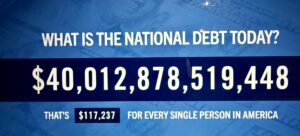
 This week the US debt pushed past $40 trillion. Why does national debt matter to us as individuals? Are we supposed to pay for that? Where is the money going? Well, according to the NY Times,
The Key Factors Driving the Debt are:
- Rising Spending: Costs for defense, military operations, and safety-net programs like Social Security and Medicare continue to expand federal outlays.
- Policy Impacts: Recent contributions include sweeping tax cuts, ongoing borrowing requirements, and tariff adjustments.
- Interest Rates: Surging borrowing costs and higher yields demanded by bond market investors feed a compounding cycle of debt accumulation.
Does government policy seem to be on track to lower the debt? Not currently.
In Trumps’ first term the debt rose by $7.8 trillion. Under Biden it grew by $8.4 trillion. In the first 18 months of Trump’s second term the debt has grown by $3.8 trillion.
Where did the money go?
Experts credit a significant portion of the growth in the national debt to the federal government’s response to the COVID-19 pandemic. According to Reuters, about one-third of the growth seen since 2017 took place during two years or so of the pandemic, when the first Trump Administration and then the Biden Administration intensified borrowing to fund the country’s pandemic response and recovery.
Additionally, according to the Brookings Institute, the tax cuts that Trump signed into law during his first year in office in 2017 were expected to contribute almost $2 trillion to the deficit by 2028. And in March, the nonpartisan Committee for a Responsible Federal Budget predicted that Trump’s “One Big Beautiful Bill,” a signature piece of his second-term agenda that also included steep tax cuts, will add $4.7 trillion to the national debt through 2035.
Most of those tax cuts went to upper income Americans. So for the vast number of Americans, the increased cost of borrowing and inflation is not helping them currently and is leading to a bleaker future. Raising the tax rates back to what they were before the Trump tax cuts is not popular. And, won’t solve all of the problems. Doing nothing however, is not a good option.
If you don’t think Vistage peer groups get value at every meeting-from the speakers, the conversations, a wise Chair, and the input from your peers, don’t click here.
Image courtesy of the Peter G. Peterson Foundation.